The Wennink report paints a bleak picture of the Dutch economy. But its reasoning is based on quicksand. The proposed solutions are not much better.
Peter Wennink has provided us with machines capable of producing 3-nanometer chips. The laws of physics cannot be bent to achieve such a goal. But anyone who wants to achieve a political goal will find that economic figures are much more flexible than physical ones. And that is exactly what happened in the Wennink Report. As Minister of Economic Affairs, Vincent Karremans had no patience for outgoing affairs, so he asked the former ASML CEO to act as a kind of Dutch Draghi, analyzing the Dutch economy and proposing solutions.
The analysis of the problems in the report is harsh.
- The report states that the renowned De Nederlandsche Bank and the Netherlands Bureau for Economic Policy Analysis expect our economy to grow by only 0.5% to 0.9% in the medium term.
- In ten years' time, every family will have €1,700 or perhaps as much as €7,000 less to spend per year if nothing is done.
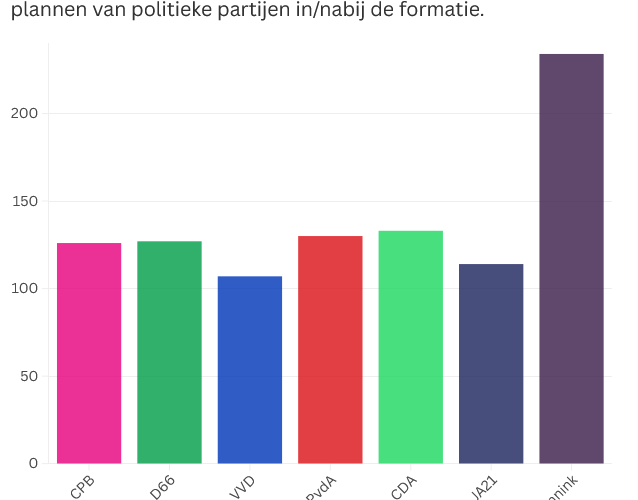
- The national debt threatens to rise to 234% by 2060 if nothing is done.
But is that really true?
According to the Wennink report, the figure of 0.5% economic growth is based on figures from De Nederlandsche Bank (DNB).
There is just one small problem: DNB does not issue any growth forecasts beyond two years. And the forecast that does exist for those years is roughly double what the Wennink report presents to its readers. It seems that Wennink and co. are basing their findings on an almost two-year-old DNB analysis in which a "stylized calculation" is made, with an "assumption" that labor productivity will grow by 0.5% per year.
The Netherlands Bureau for Economic Policy Analysis also expects higher growth in the coming years than the 0.9% mentioned in the report. It will not reach the Wennink level until the early 2030s.
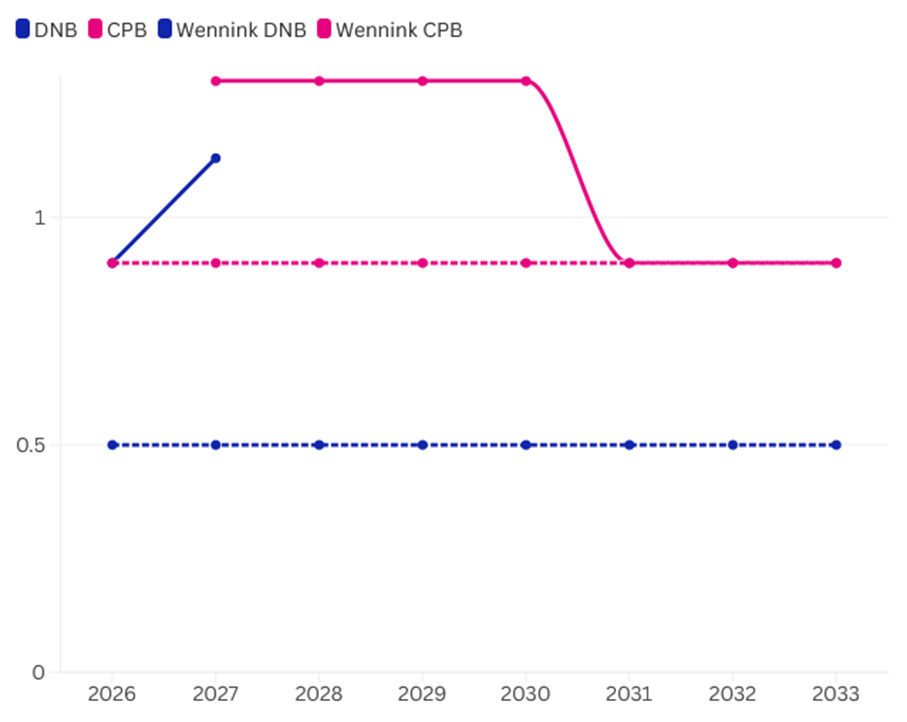
All this means that the gap Wennink describes between the growth the Netherlands 'needs' (1.5-2%) and the expected growth (0.5-0.9%) is much smaller in practice.
Are we becoming poorer?
Then there is purchasing power. According to the CPB, this will increase by 0.6% per year until 2033, and that figure does not even take into account factors such as promotions or pay rises. That is quite different from the decline of €1,700 per year that Wennink claims. In any case, that decline is remarkable. Even if the economy grows by 'only' 0.5%, you would still think that people would be better off. Unless other parties in the economy are stealing growth at the expense of households. That is exactly what Wennink is calculating here.
He assumes that in the coming years, the government will do all the nice things that are on the table (extra money for defense and climate, for example), without increasing the national debt and without making cutbacks. In other words: everything must be paid for by extra taxes for citizens and businesses.
There is just one small problem: no political party is proposing this. The elections on October 29 were precisely about this: which party will make which choices? Where should we invest, what should we put on hold, and where should we cut back? 7.4 million people voted for parties that had their plans calculated by the CPB and often chose not to finance everything with tax increases. The scenario that Wennink outlines is therefore far removed from political reality.
The declining effect of purchasing power is further exacerbated by the fact that it is calculated per household. However, the Central Bureau of Statistics expects 400,000 single-person households to be added during that period. Total income will therefore be divided among a larger group, with fewer people in each household.
Fat, dumb, happy, and in debt?
Then there is the national debt. According to Wennink's report, it would amount to 234% in 2060 'if policy remains unchanged'. The report is again based on a CPB estimate. But that is strange, because the figure 234 does not appear at all in that CPB report. In fact, the planning agency states that 'if current policy continues', the debt will amount to 126%. That is more than 100% less, a difference of more than €1,000 billion.
Wennink—or his calculators—have selectively cherry-picked information from the CPB report.
This article is for subscribers only
To continue reading this article, just register your email and we will send you access.
Subscribe NowAlready have an account? Sign In