The chip industry has become the hope in fear for Dutch industry. But does this industry still have a future for our small country, now that big China is throwing its full weight behind it? 'If I were the king of Europe, I would impose a lot of tariffs on the Chinese chip industry.'
ASML is now not only Dutch pride, but is now Europe's pride. It is almost the EU's most valuable company, just behind German software giant SAP. And while many Dutch manufacturing companies are struggling, the chip industry continues to grow. So it makes sense to think: Put all your balls on the chip industry!
But is it? Because there is a big hijacker on the coast: China. The country already accounts for more than a quarter of all the world's industry. It not only makes more cheap mass-produced goods, but also more and more high-tech stuff. Chinese companies dominate, for example, in making electric cars. Almost half of all patents filed for new technology, meanwhile, come from China.
Battle for the chip market
And China is now eager to conquer the chip industry as well. Not only because chips are crucial to many new technologies, such as artificial intelligence (AI). But also because the United States is using its own dominance in this field to thwart China. For example, under U.S. pressure, the Netherlands has decided that ASML cannot sell its latest generation of EUV chip machines to China.
China previously competed to the death with the European solar panel industry. And now the European car industry must pull out all the stops to avoid the same thing happening to it. Now China is deploying its already strong industrial base, innovative strength and enormous economies of scale in the production of chips. Isn't it simply a matter of time before the Dutch chip industry - Europe's most important chip cluster - is also affected? Is it then wise to bet all the balls on that sector?
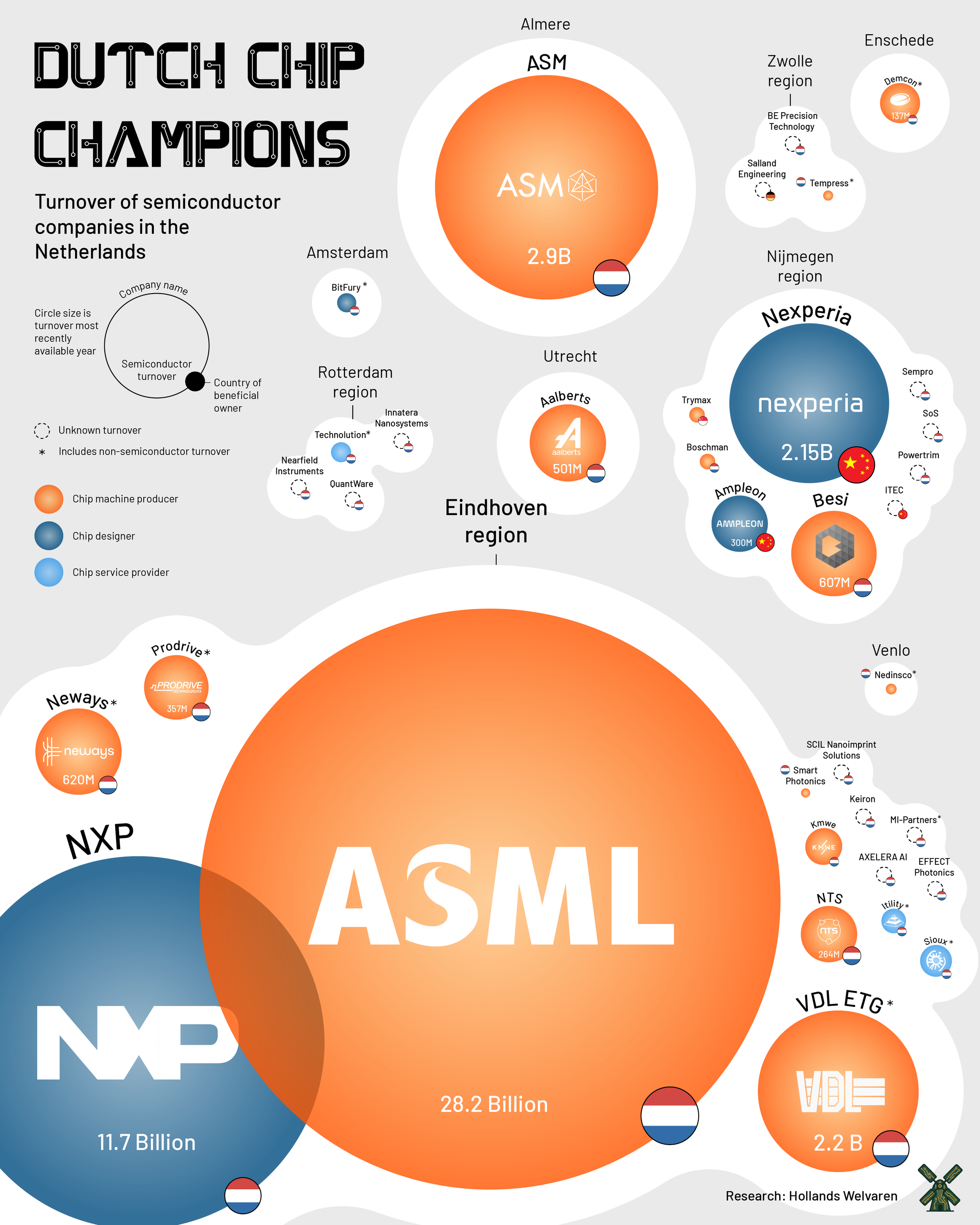
Anyone who wants to set up a chip industry first needs chip machines to make those chips. This is reflected in ASML's annual figures. As recently as 2022, ASML supplied two-thirds of its chip machines to the East Asian democracies of South Korea (Samsung) and Taiwan (TSMC). Since then, China has gone on a buying spree. China may not buy state-of-the-art EUV machines, but it may buy older models. It now buys chip machines from ASML for almost as much money as those other two countries put together.
With those machines, China cannot make the most advanced chips for artificial intelligence, or for in the latest iPhone. But for just slightly less advanced chips, it works just fine. And that's still the bulk of the chip market: refrigerators, cars, robotic vacuum cleaners.
What is the chip market like?
Very roughly, there are three types of players. There are the designers who design chips. Think of Apple working on an even hipper iPhone, or Nvidia inventing the world's most advanced AI chips. However, these companies do not make these chips themselves. They do so in giant factories (often a foundry, or fab ), such as those of TSMC (Taiwan), Intel (America) and Samsung (South Korea). But those factories can make those chips only with the most advanced machines from machine makers. And in the latter, the Netherlands excels (see the orange companies in the infographic above).
According to chip expert Chris Miller, author of the book Chip War, it was 'wise' to prohibit ASML from selling the EUV machines to China and thus slow down chip development there a bit, he informs Hollands Welvaren. 'China's economic model is aimed at becoming less dependent on European imports.' China still needs the ASML machines now, but that is an exception, Miller says. 'The German automakers are already crushed. A more powerful China is not good for Dutch interests.'
Last chance
Subscribe now with early bird discount to Hollands Welvaren:
40 euros a year, instead of 50 euros AND the guarantee that the price never rises. Only in August.
Arrian Ebrahimi, a doctoral student at Georgetown University and author of the Chip Capitols newsletter, also fears the advance of the Chinese chip industry. China is pulling ahead of its own (chip) industry with subsidies and other measures, making it harder for European chip companies to compete. 'If I were the king of Europe, I would introduce tariffs on a lot of Chinese industries, including the chip industry,' he said. To force China to stop subsidizing their own industry.'
Export ban ASML machines to China: good or bad policy?
Still, Ebrahimi thinks it is precisely a bad idea to ban the export of EUV machines to China. 'Chinese chip companies are relying more and more on themselves as a result.' They are putting more effort into developing their own chip machines. They have also begun to focus more on selling chips domestically so that Trump cannot squeeze their sales market overnight. 'In doing so, they are pushing European chip companies, such as NXP, away from the Chinese market.'
NXP is the second largest chip company in the Netherlands after ASML in terms of revenue. It mainly supplies the automotive industry and gets more than a third of its sales from China. Among other things, Ebrahimi conducted research into Chinese subsidies for chip companies. He saw that because of those subsidies, among other things, Chinese companies can operate at a loss for a while without problems and still continue to put money into innovation. That is more difficult for American and European chip companies exposed to the discipline of the stock market.
'Volkswagen is too influential in Brussels and blocks backlash against China'
'If European chip companies lose market share in China, that also affects their research budgets in Europe,' says Ebrahimi. This threatens to create a vicious circle: less sales now means less research and fewer new products in the future. 'Unlike America, Europe does not dare to put counter pressure on China. German car companies in particular are too dependent on the Chinese market for that. Companies like Volkswagen are too influential in Brussels. In the long run, that does spell disaster for the European chip industry.'
Can China do what ASML can do?
While China is pushing out the European chip industry, ASML seems to be getting away with it. By selling chip machines to China, it is actually benefiting from that country's advance. Making chips requires numerous specialized machines, of which ASML's lithography machines are just one. But it is a crucial component, and without ASML's EUV machines you cannot make the latest generation of AI chips. The lithography process is so complex that (even) China just can't seem to master it.
This article is for subscribers only
To continue reading this article, just register your email and we will send you access.
Subscribe NowAlready have an account? Sign In