For hundreds of years, we have been one of the most prosperous countries in the world. Historically speaking, there is one major threat to that prosperity: war. So how do we prevent the Netherlands from falling victim to the geopolitical tensions and shifting power dynamics between the United States, Europe, Russia, China, and Iran? “Sacred cows are standing in the way of our strategy.”
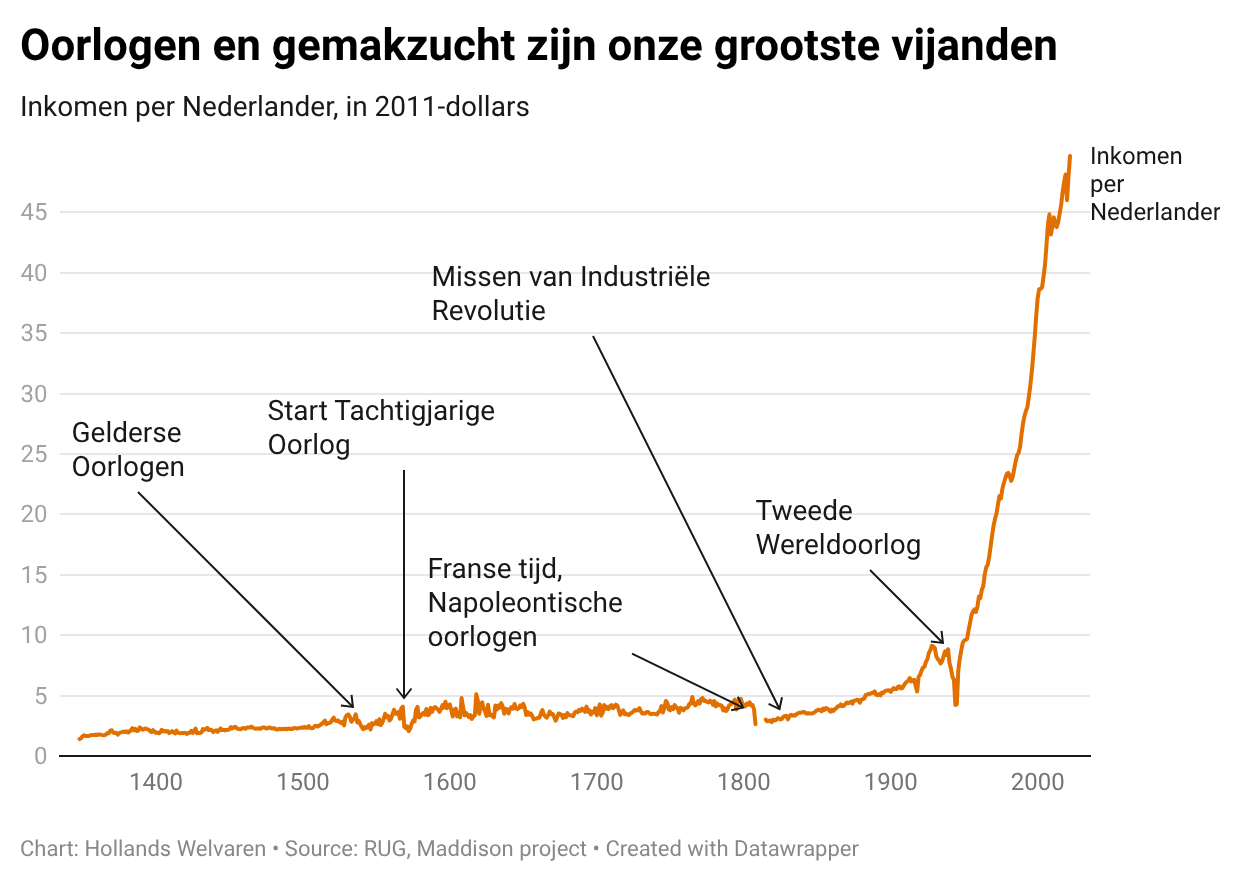
Take a look at the graph below showing the income of the average Dutch person since 1348 (!) and try to find the Golden Age. You won’t see it. The data comes from the impressive Maddison Project at the University of Groningen. It also shows that the term “reconstruction” is completely misapplied. We didn’t “rebuild,” but we did become more prosperous than ever before.
What you can clearly see in the graph are wars—with all the misery and hunger that come with them.
The Boomer Wars
Four years ago, on February 24, the Netherlands—along with many other European countries—was brutally jolted awake by a new war on the continent. Russia invaded Ukraine with a massive show of force. Since then, fears of escalation and hybrid warfare have prevailed, and defense spending has been significantly ramped up as a deterrent against Russia. The shutdown of the flow of cheap Russian gas dealt a blow to industry that is still being felt today.
On February 28 of this year, two other baby boomers voluntarily chose to start yet another war: Israel and the United States attacked Iran, which then blocked the Strait of Hormuz, bringing virtually all oil, gas, and fertilizer trade through the Strait to a standstill.
"When the director of the International Energy Agency (IEA) says that this crisis is more severe than the oil crises of 1973 and 1979 combined, plus the invasion of Ukraine, then you are dealing with a mega-crisis in every sense," says Noé van Hulst, former chair of the Governing Board of the IEA, to Hollands Welvaren. “We need to shift much more into crisis mode. That’s something I don’t see at all in Europe and the Netherlands.”
Due to the crises of recent years—including not only wars but also the COVID-19 pandemic—the call for “strategic autonomy” has grown; people no longer want to be dependent on oppressive regimes such as Putin’s, or on autocrats in the Middle East or China. But there is a problem: the world is rapidly becoming less democratic, as was painfully clear last week from a report by the Swedish democracy research group V-Dem Institute.
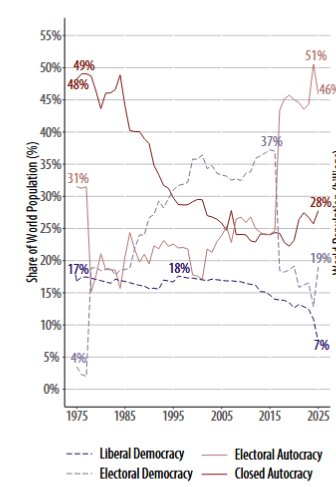
According to the institute, only 600 million people (7% of the world’s population) live in a liberal democracy like ours, with fair elections and freedom of speech. In fact, three-quarters of the world’s population lives in an autocracy.
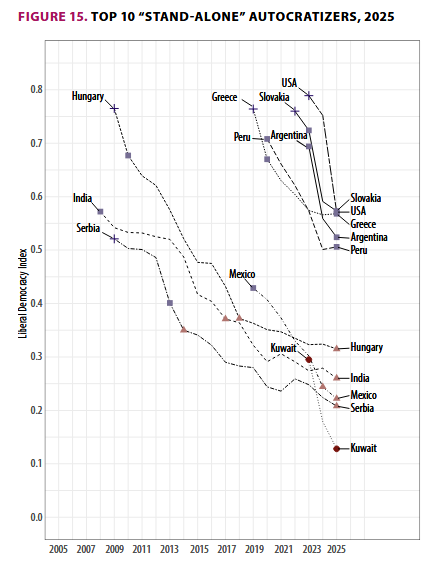
Around the turn of the millennium, the situation was quite different: half the world lived in a democracy, and autocrats were on the decline. But now, one democratic “ally” after another is falling by the wayside. In Hungary and India, the decline of democracy has been gradual; in the United States, it is now happening at breakneck speed, according to the V-Dem Institute.
Source: V-Dem Institute
It’s like walking into a new classroom, looking around, and not seeing any friends. How do you cope in that situation?
"Europe has a number of sacred cows that I believe structurally hinder our strategic stance," says China expert Frank Pieke, co-founder of the Leiden Asia Centre and now a professor in Singapore. "In the Netherlands, for example, you can’t say that perhaps we shouldn’t always support Israel. Israel is now a disruptive force in the Middle East, and that runs diametrically against our European interests in a stable Middle East where oil flows freely.”
For decades, Israel—and the United States as well—were both natural and democratic allies. Allies on whom we became increasingly dependent, as we sought to reduce our reliance on autocratic regimes. Russian pipeline gas was replaced by American liquefied natural gas (LNG).
"You have to be very tactful in your diplomatic approach right now," says Van Hulst. “Fortunately, that’s happening now; I saw that Prime Minister Jetten called MBS [Saudi Crown Prince Mohammed bin Salman, HW]. Of course, we’ve kind of let that slide in the past, because we all thought it was too complicated to deal with non-democratic countries. But if you stay stuck in that mindset, you’re completely lost.”
How should we deal with the United States?
According to Pieke, Europe has a lot of catching up to do. “In Asia, they think: let Europe talk all it wants. The center of power is in Washington, and ultimately, Europe will always go along with whatever the Americans do and want. They recognize that Europe is economically important and want to benefit from that, but strategically, Europe isn’t seen as a mature player.”
To strengthen that position, Pieke believes Europe must distance itself further from the United States. In a short period of time, the United States has sparked a trade war with virtually the entire world, kidnapped the Venezuelan president, attacked Iran twice, is strangling Cuba, and is threatening to annex Greenland (and Canada). “The greatest threat in the world today, including for Europe, is the United States,” says Pieke. “There is no doubt about that.”
How should we deal with Russia?
"As Europe, we need to start taking more responsibility for ourselves, but as long as the conflict in Ukraine remains unresolved, we’re stuck with America," says Pieke. “That’s another sacred cow: you’ll have to make concessions to Russia, such as acknowledging that Ukraine is a buffer state that will never join NATO. For Europe, that’s unacceptable, because then we lose and give the Russians what they want. I don’t think that’s true; I believe this creates room for us to become militarily stronger and less dependent on America.”
If the war between Ukraine and Russia ends, the option of importing cheap Russian gas again will also be on the table. Belgian Prime Minister Bart De Wever recently said: “If there is a peace treaty that is acceptable to Ukraine and Europe, we should be able to reestablish economic relations with Russia. I think that’scommon sense.”
Pieke agrees with De Wever, while Van Hulst is more cautious: “Given the security threat posed by the Russians, that’s not on the table right now, but it could come up again at some point. That would be ideal leverage in a peace agreement. You do need to start thinking about it and preparing for it now.”
According to Van Hulst, the key is to spread out risks. “Diversification is the magic word: you have to make sure you don’t rely too heavily on a single country or a single transport route—no more than 20%, for example.” Diversification also means using multiple energy sources that you can switch between, such as gas and coal-fired power plants. And, above all, producing more energy domestically, such as from gas fields and wind energy.
How should we deal with China?
This article is for paid members only
To continue reading this article, upgrade your account to get full access.
Subscribe NowAlready have an account? Sign In