For years, politicians ignored the earthquake crisis in Groningen, only to then make a radical about-face. In their rush to close the Groningen gas field, they overlooked something else: the Netherlands’ gas supply security. One million jobs are at risk in the event of a gas crisis. 'At times, it seemed as though you could only take one of two positions: either you were in favor of closure and asked no questions, or you asked questions and were therefore against closure.' Does that mean 'Groningen' has to reopen after all?
In this story, you'll read:
- How many recommendations politicians ignored when they closed the Groningen field
- How vulnerable we are right now
- How significant the impact of a gas crisis would be
- Whether it is wise to resume production at the Groningen gas field after all, or whether there are alternatives
For this article, we spoke with energy expert Jilles van den Beukel, TNO Gas Technology Director René Peters, and former VVD Senator Caspar van den Berg.
Two years and two days ago, the House of Representatives voted—with a North Korean-style majority (146 out of 150 seats)—to permanently close the Groningen gas wells. There was a sense of urgency: the closure had to be final by October 1 . Pour concrete into them, and never look back. “Only the memory remains,” as the Groningen singer Ede Staal sang.
This created a problem in the Senate, which was scheduled to vote on the matter a few weeks later. As a “chambre de réflexion ,” the Senate is supposed to try to keep current events out of the equation and evaluate bills based on their substance. Is the consensus in the House of Representatives truly justified, or is it simply a case of herd mentality? These are not unreasonable questions, given the long list of critical reports.
- According to the Council of State, closure would have "far-reaching consequences," and "the impact of its closure on the desired level of security of supply has not been adequately assessed."
- TNO, the government’s technical and geological advisor, stated that it was “essential” to first conduct a more thorough investigation into “the use of the Groningen field as a strategic gas reserve [..] in order to make an informed decision on whether or not to close and permanently decommission the Groningen field.” Such a reserve function would have little or no impact on the risk of earthquakes.
- "The risk of a disruption in the gas supply [due to the closure of the Groningen field, HW] has not yet been quantified," wrote the Mining Council. "The Mining Council believes that without adequate answers to the above questions, gas extraction from the Groningen field can be phased out, but not irreversibly terminated."
- “The security of natural gas supply is [following the closure of the Groningen field, HW] no longer a given,” Gasunie noted matter-of-factly—acting not only as a state-owned company but also as a government advisor on gas supply security—two weeks after the vote in the House of Representatives, but before the vote in the Senate.
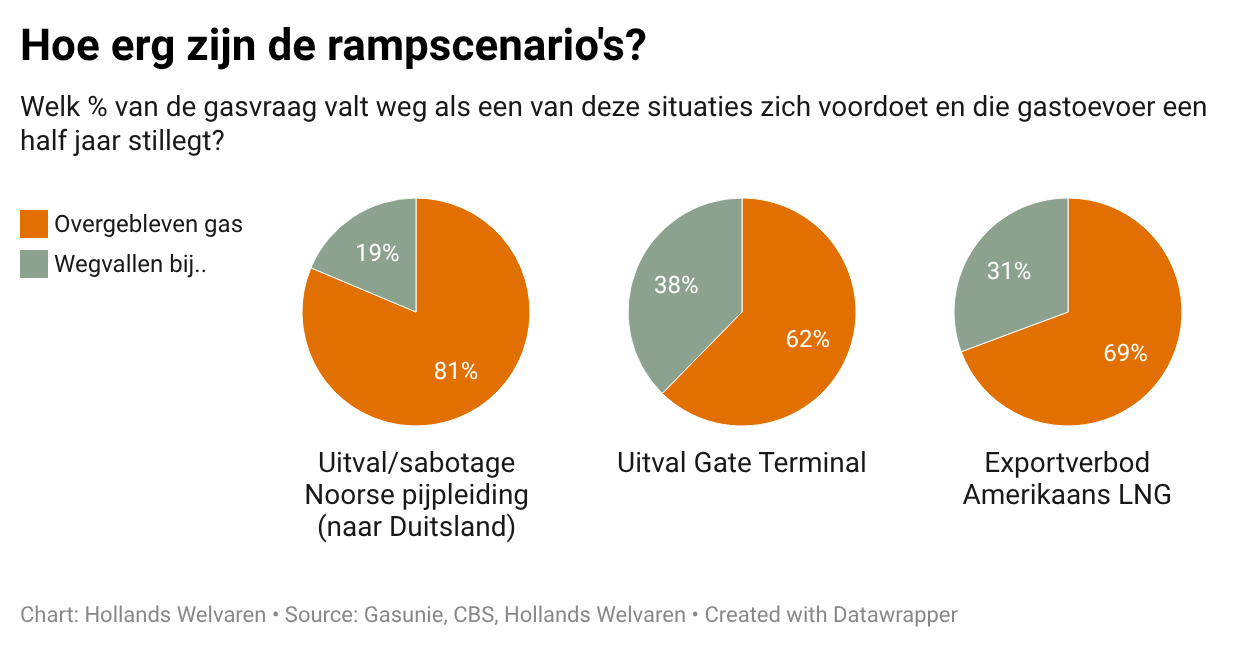
- Anyone who had looked carefully might have found a report by the economic research firm SEO in a drawer, detailing the consequences of a physical gas shortage. If non-essential industries have to shut down because there really is no more gas, that would result in an economic contraction of about 10% and cost about 1 million people their jobs. That contraction would be roughly three times larger than the one following the credit crisis, and ten times larger than the Great Depression of the 1930s.

The discussion that never happened
In short, there was a lot at stake with this bill. But when senators wanted to take their time, State Secretary Hans Vijlbrief dropped a bombshell: if that happened, he would resign; “Groningen” had to close by October 1, no matter what.
“My party’s position at the time was actually quite simple: gas extraction in Groningen had to stop, but Parliament also had a duty to consider how the Netherlands would secure its energy supply afterward,” Caspar van den Berg Hollands Welvaren at the request of Hollands Welvaren . As a VVD senator, he raised questions about the closure at the time. “It sometimes seemed as though you could only take one of two positions: either you were in favor of closure and asked no questions, or you asked questions and were therefore against closure. The reality is, of course, much more complex, and that is what my party wanted to draw attention to.”
Van den Berg was accused by his Volt colleague Perin-Gopie of using “the S-word”: security of supply. D66 Senator Aerdts put a rhetorical spin on the questions: “I think we can say that tonight we’ve given new meaning to the concept of ‘security of supply,’ namely: a state secretary who delivers.” Aerdts recently assumed the role of State Secretary responsible for sovereignty.
This article is for paid members only
To continue reading this article, upgrade your account to get full access.
Subscribe NowAlready have an account? Sign In