Foreign companies have invested a staggering €3,302 billion in the 'real' Dutch economy. This puts the Netherlands among the absolute world leaders. It makes the Netherlands richer, but also more powerless; more strategically dependent, but also strategically important. But there is a catch. The new cabinet must resolve this, but it is torn between 'open' ministers and 'autonomists'.
For an English version of this article, click 'Nederlands' in the right hand corner of your screen and switch to 'English'. Or just click this link.
In this article, you will read:
- how unique the Netherlands is when it comes to foreign investment
- why that makes our country so much more prosperous
- but the Netherlands also makes it dependent on other countries
- why politics has exacerbated this problem
- why the Netherlands is particularly unsuited to the idea of strategic autonomy
- what politics could do to turn the tide
Shell? Gone. Unilever? Gone? AkzoNobel and DSM? After a merger, they have one foot abroad. How awful, right? It often seems that our business climate is in a terrible state. You hear this same list repeated ad nauseam whenever even one company mentions the possibility of leaving, and panic strikes again.
But that means we're looking in the wrong direction.
Of course, Dutch multinationals are important to our economy, but foreign multinationals are much more important. They have invested €3,302 billion in Dutch factories, data centers, offices, and other businesses, according to figures from De Nederlandsche Bank (DNB). Letterbox companies are excluded from this.
This puts the Netherlands among the absolute world leaders. The OECD, which uses its own figures, counts only three countries that have attracted more foreign investment than the Netherlands. The Netherlands ranks fourth after the United States ($16,388 billion), China ($3,622 billion), and the United Kingdom ($2,504 billion). And that with a population of 18 million.
If you compare foreign investment with the size of the economy, you will see that only the tiny state of Luxembourg attracts more foreign investment than the Netherlands (214% of our economy). In America, the figure is 56%, in Germany a meager 27%, and in China 19%. This means that the Netherlands really does have a fundamentally different economy to these countries: it is much more intertwined with the rest of the world.
Abroad versus the Netherlands
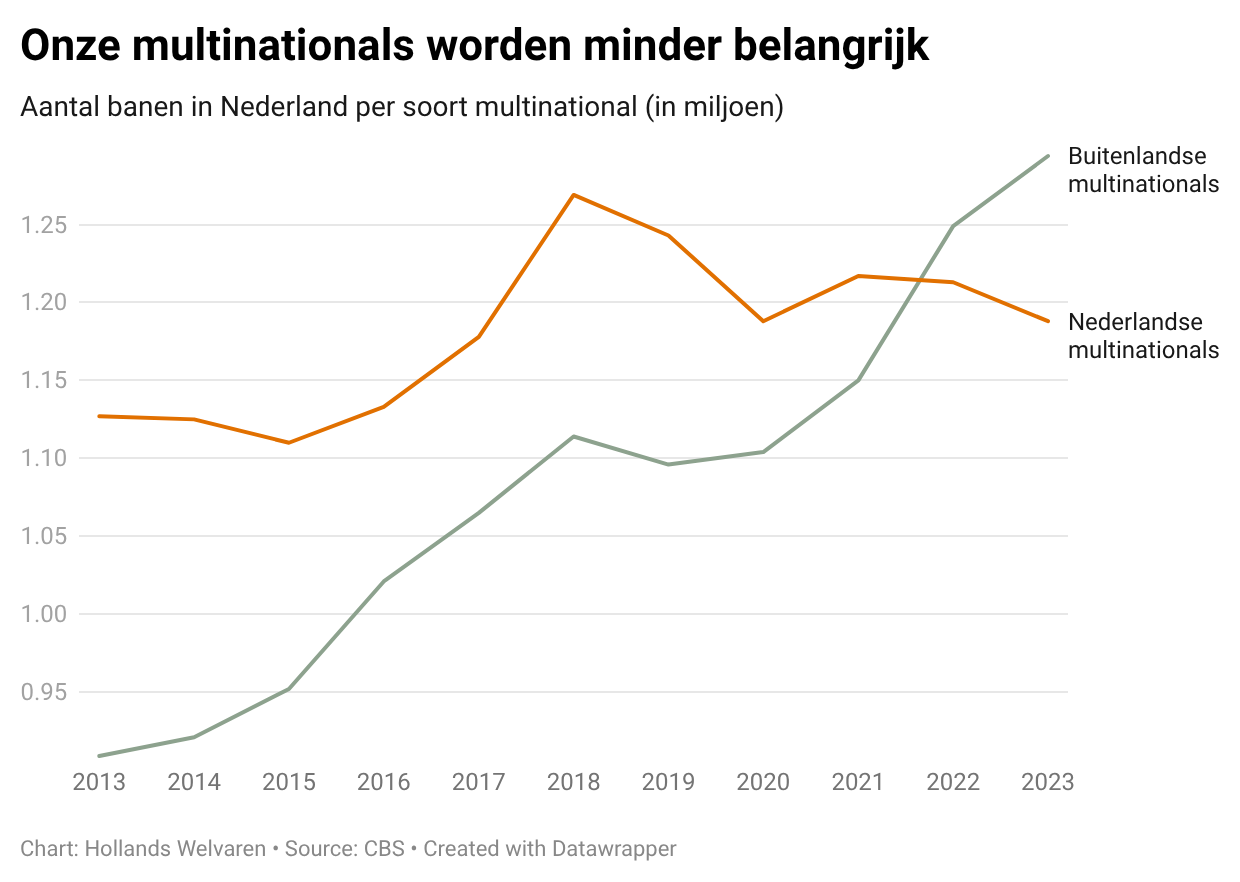
According to figures from Statistics Netherlands (CBS), there are almost 18,000 foreign multinationals operating in our country. Together, they employ 1.3 million people. This means that, for the past few years, they have been employing more people than Dutch multinationals.
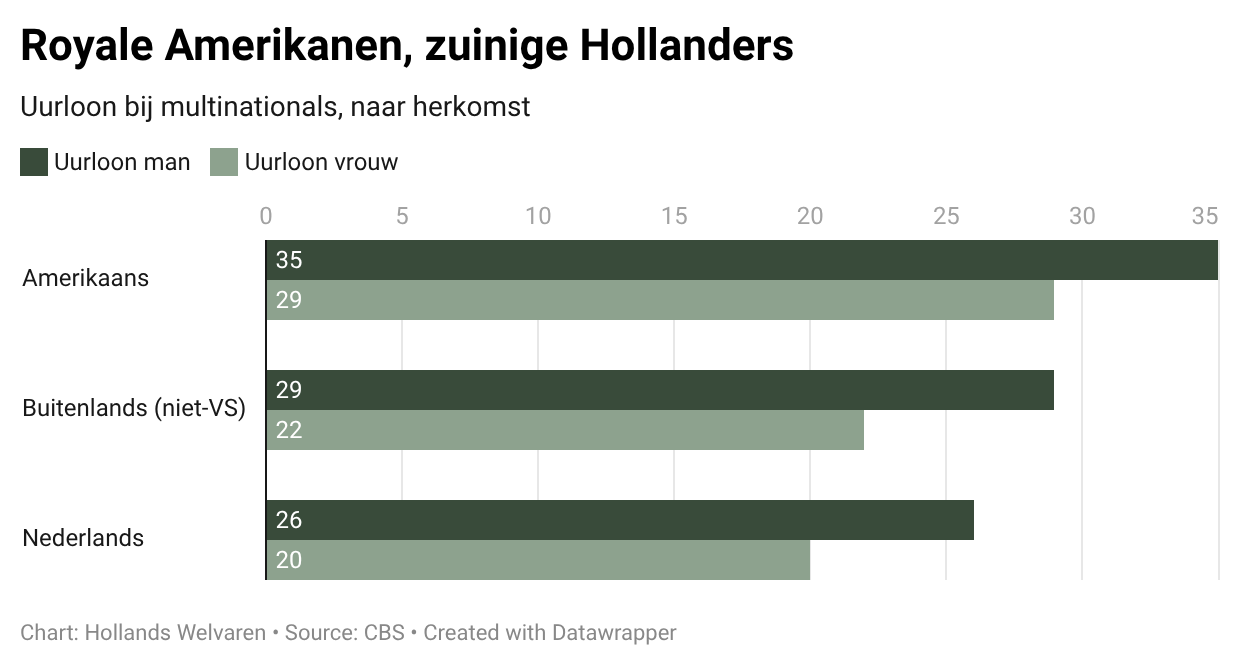
And they pay better too. Employees earn €9 more per hour at an American multinational than at a Dutch one, according to calculations by Statistics Netherlands (CBS). Not because Americans are so much more socially minded, but simply because American companies earn a lot more money. Over the years, various American tech companies have chosen to establish their European headquarters in the Netherlands, often in Amsterdam. Think of Uber, Netflix, and Tesla. The advantage: if such a company grows rapidly, the Netherlands grows along with it almost automatically.
Where do all these foreign companies come from?
For years, the Netherlands was dismissed as a tax haven that mainly attracted letterbox companies. Something dirty that we had to get rid of. Certainly during the Rutte 3 cabinet, the then State Secretary for Finance Hans Vijlbrief took an axe to the tax haven (the question is whether, as Minister of Social Affairs, he will now take the same blunt axe to the welfare state).
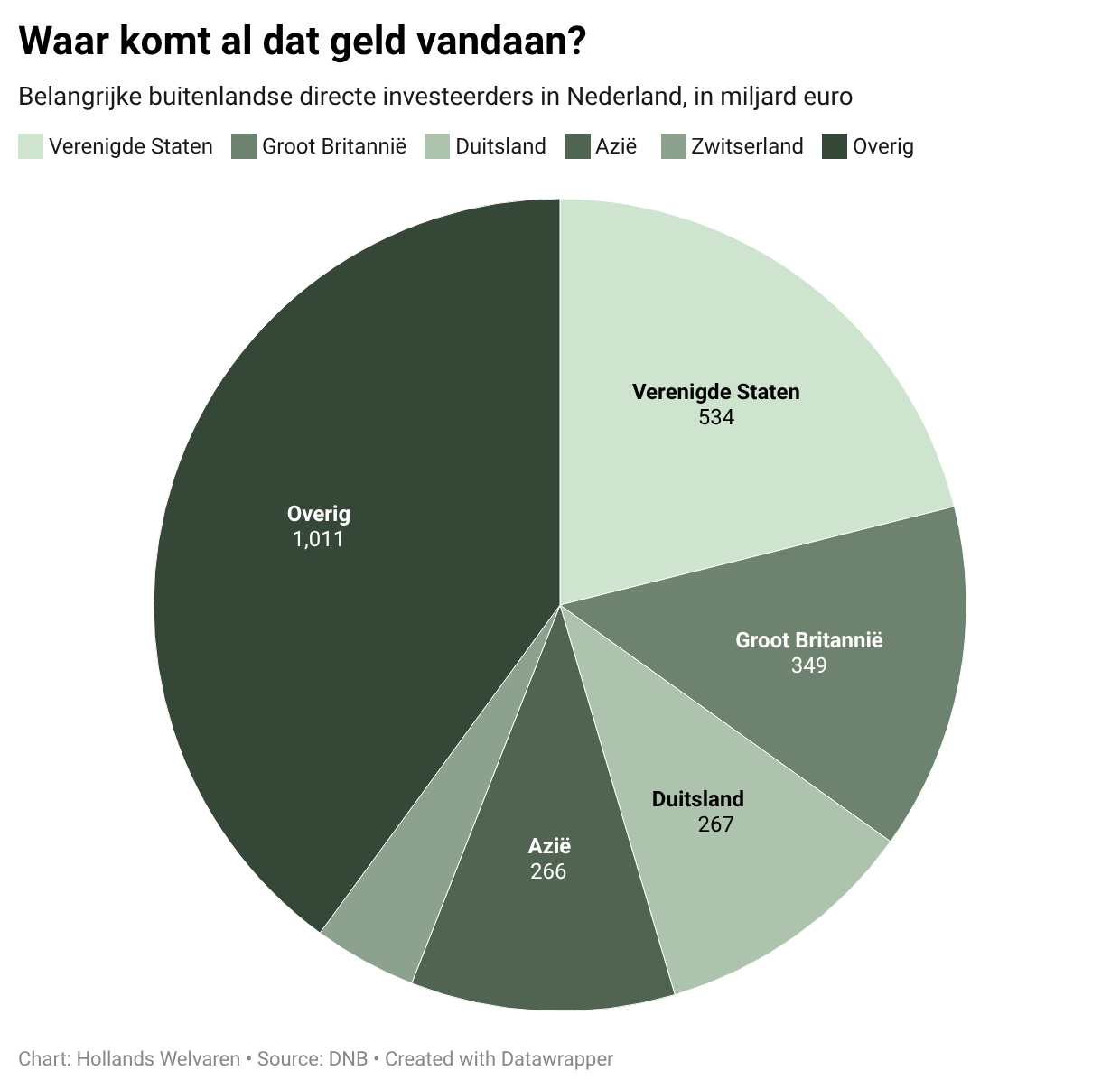
But all those fictitious billions flowing through the Zuidas obscured the view of the gigantic real flows of investment. More than 500 billion euros comes from America, followed by the British. Although the Netherlands is part of the EU, less than half of the money comes from our fellow EU member states. This indicates that the Netherlands is not so much a true EU economy as a link between the Anglo-Saxon world and continental Europe.
What are all those foreign companies doing here?
Foreign multinationals operating here are as diverse as the Dutch economy itself. And the definition of foreign direct investment (FDI) is also broad. So broad that you might wonder how 'real' some of them are, even though letterbox companies have been filtered out. This is particularly true in the financial sector. But the investments that do land in the Netherlands are enormous.
There are American companies, such as Dow Chemical, which have been building their largest chemical park outside America from scratch here since the 1960s. When a foreign company takes over a Dutch company, this also counts as a foreign investment. Think of the American company PACCAR, which revived the bankrupt truck manufacturer DAF in the 1990s with money and knowledge transfer. Or Tata Steel, which bought the former Hoogovens. Eli Lilly is going to build a drug factory in the Netherlands for 2.6 billion, while other pharmaceutical giants mainly conduct research here.
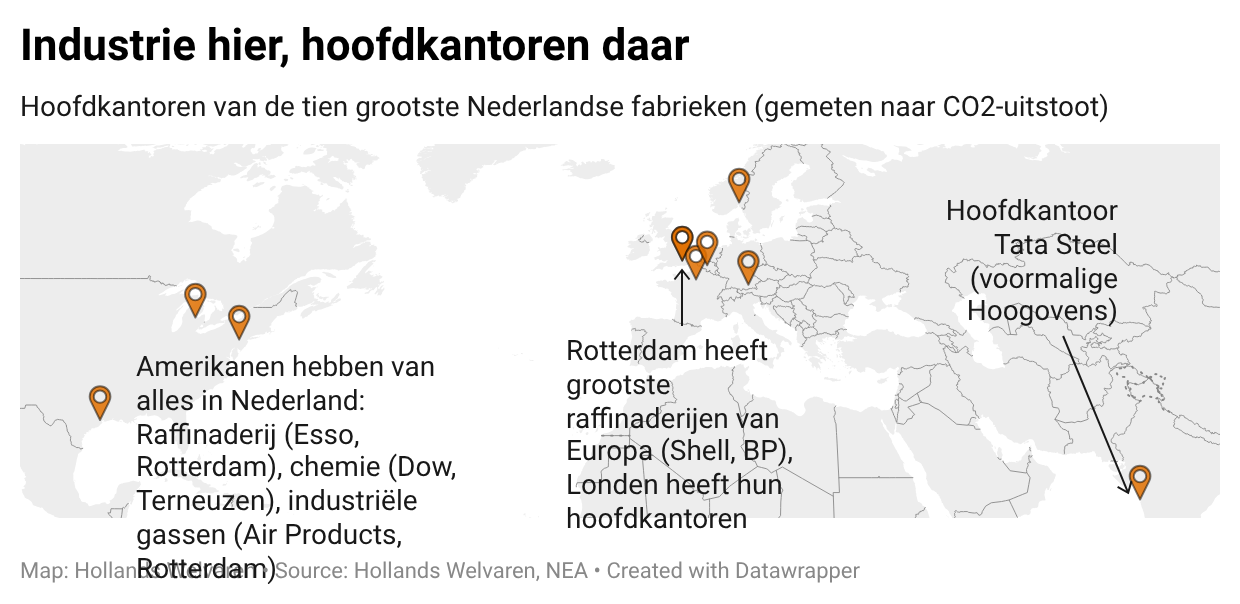
When you rank Dutch industry according to CO2 emissions (the more emissions, the larger you are, after all), you see that the ten largest factories are all foreign-owned.
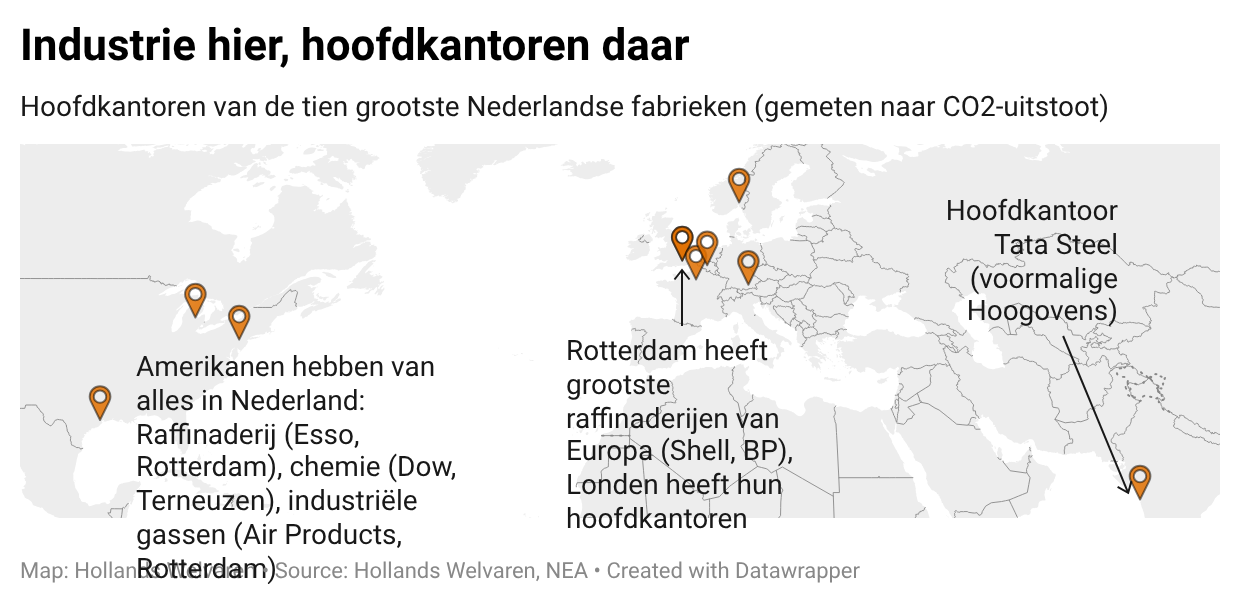
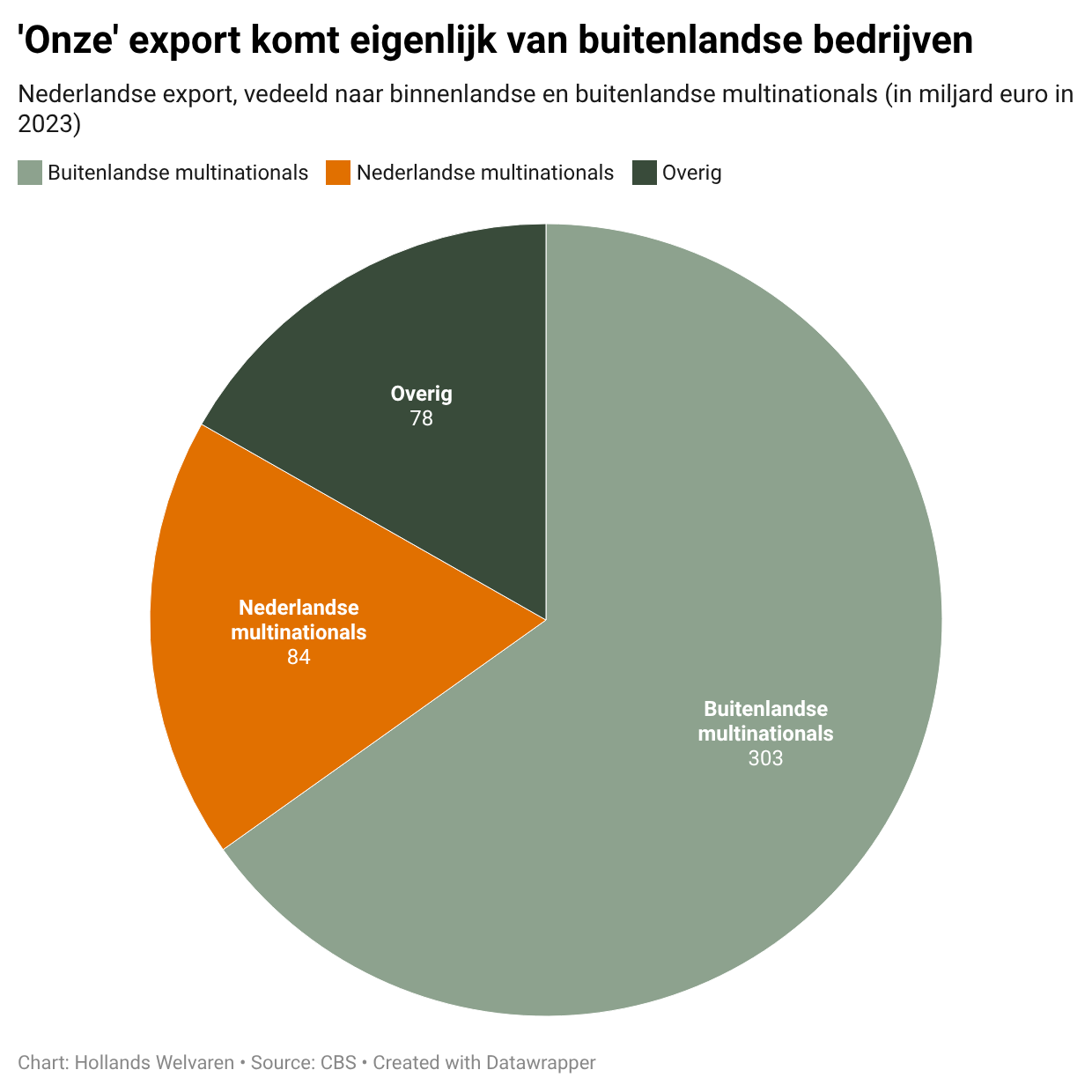
This is also reflected in our export figures. According to figures from Statistics Netherlands (CBS), around two-thirds of Dutch exports come from foreign multinationals.
In addition to this industrial activity, which accounts for more than 200,000 jobs, there is also a lot of office work to be done, such as at the aforementioned regional headquarters of Tesla or Nike in Hilversum. More than 100,000 people also work in ICT, for example at IBM, Google, or Booking.com.
And then it stopped
This article is for paid members only
To continue reading this article, upgrade your account to get full access.
Subscribe NowAlready have an account? Sign In